
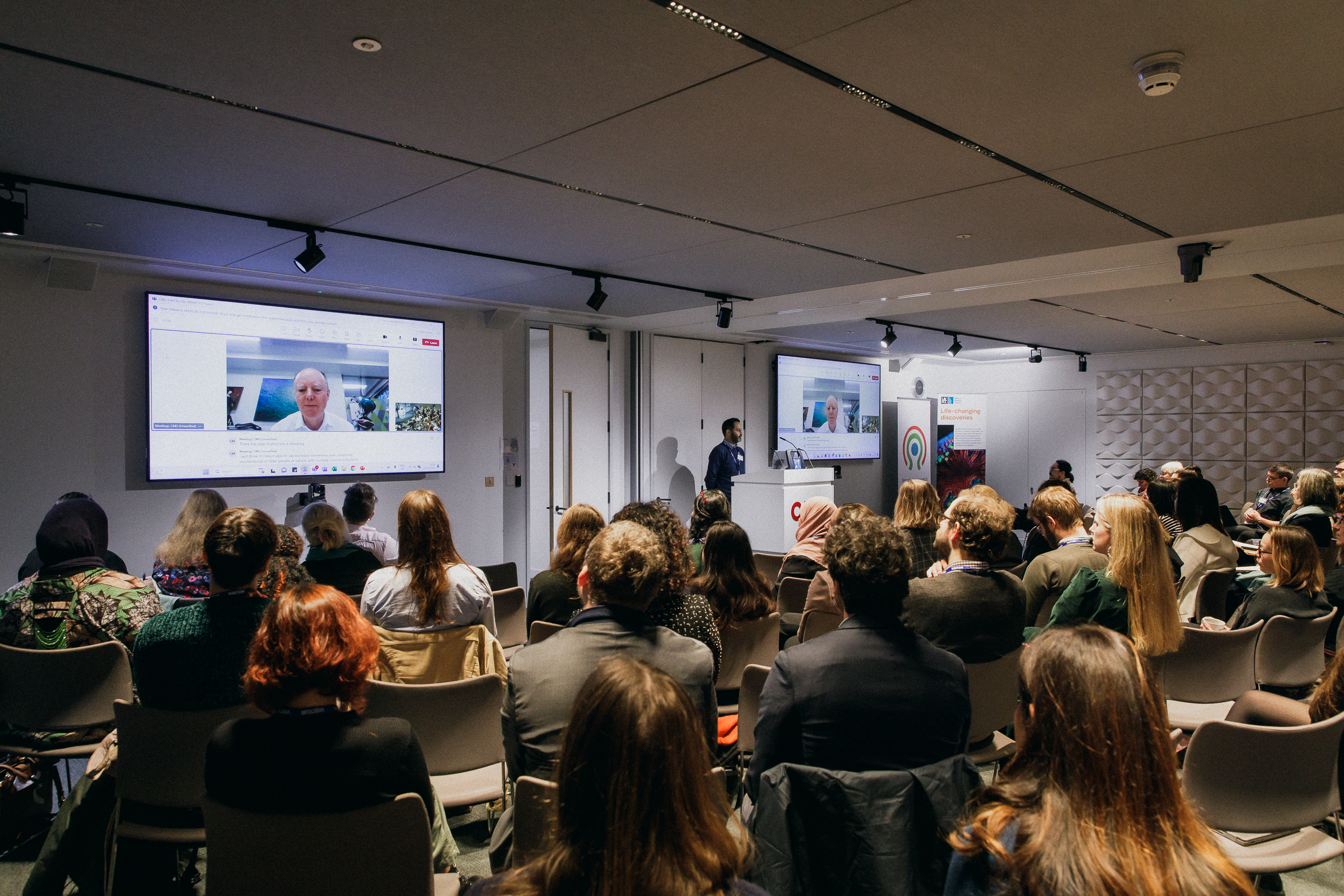
On the 7th February 2025, the UK Ageing Research Funders’ Forum (UKARFF) held an Early Career Researcher (ECR) event hosted by the Health Foundation in Central London.
The day was full of interactive sessions, kicking off with a question and answer session with the Chief Medical Officer for England, Professor Sir Chris Whitty. Attendees’ questions focussed on the key priorities from the Chief Medical Officer’s annual report 2023: health in an ageing society.
This was followed by a series of eight engaging talks from ECRs funded by different UKARFF members:
- Dr Manik Deepak Gopinath and Dr Mahera Ruby (funded by Vivensa Foundation), from The Open University, shared insights on designing appropriate living environments for older adults, particularly focusing on the unique needs of older minority ethnic groups. Watch the presentation and learn more about it here.
- Dr Jingwen Zhang (funded by the Economic Social Research Council), from the University of Manchester, discussed how means-tested social care funding impacts older adults’ use of care services, using data from the English Longitudinal Study of Ageing (ELSA). Watch the presentation and learn more about it here.
- Dr Laura Gray (funded by the Medical Research Council), from the University of Sheffield, presented the findings on obesity trends in older adults, using data from the Health Survey for England, highlighting the importance of using appropriate measures to accurately assess obesity in this age group. Watch the presentation and learn more about it here.
- Dr Lindsey Sinclair (funded by Alzheimer’s Society), from the University of Bristol, spoke about the findings comparing gene expression in different parts of the brain in people who lived with Alzheimer’s and those who had Alzheimer’s and new onset depression. Learn more about it here.
- Dr Elisa Martelletti (funded by RNID and the Vivensa Foundation), from King’s College London, presented preliminary results comparing the inflammation response inside the cochlea before and after the onset of hearing loss, showing that inflammation in the cochlea is not a secondary effect to hearing loss, but rather contributes to it. Watch the presentation and learn more about it here.
- Dr Michael Stringer (funded by Stroke Association), from the University of Edinburgh, presented work showing that differences in vascular dysfunction between sporadic and genetic small vessel disease were tissue specific and related to disease severity — rather than differing by disease subtype. Watch the presentation and learn more about it here.
- Dr Aimee Parker (funded by the Biotechnology and Biological Sciences Research Council), from the Quadram Institute, explored how our gut microbiota can be harnessed to promote health in older age, offering valuable insights into how age-related decline could potentially be delayed or prevented through modifications to the gut microbiota. Learn more here.
- Dr Ceylan Beşevli (funded by the Engineering and Physical Sciences Research Council), from University College London, presented the latest findings from the “Nose Gym” project, exploring the barriers and motivations associated with daily smell training. Watch the presentation and learn more about it here.
In our final session, we were joined by Professor Catherine Green, from the University of Oxford, who gave a talk on her involvement in the development of the Oxford-AstraZeneca COVID-19 vaccine, with the focus on research translation and public engagement. Professor Green explained how collaboration, translation of research and public engagement are essential for vaccine development and uptake. Professor Green described what makes the Jenner Institute — where the Oxford-AstraZeneca COVID-19 vaccine originated — unique and well placed to take vaccines from ideas in a lab to first-in-human trials. She covers the Institute’s vaccine manufacturing platform, approach to pandemic preparedness and ‘just get it started’ attitude as some of the many factors that makes it successful in vaccine development.
You can also see the amazing posters from the day here and the photos from the event here.
A big thank you to everyone who attended and contributed to making the day a fantastic showcase of ageing-related research in the UK. Your participation and insights helped make it a truly memorable and impactful event (see a short highlight video here)!