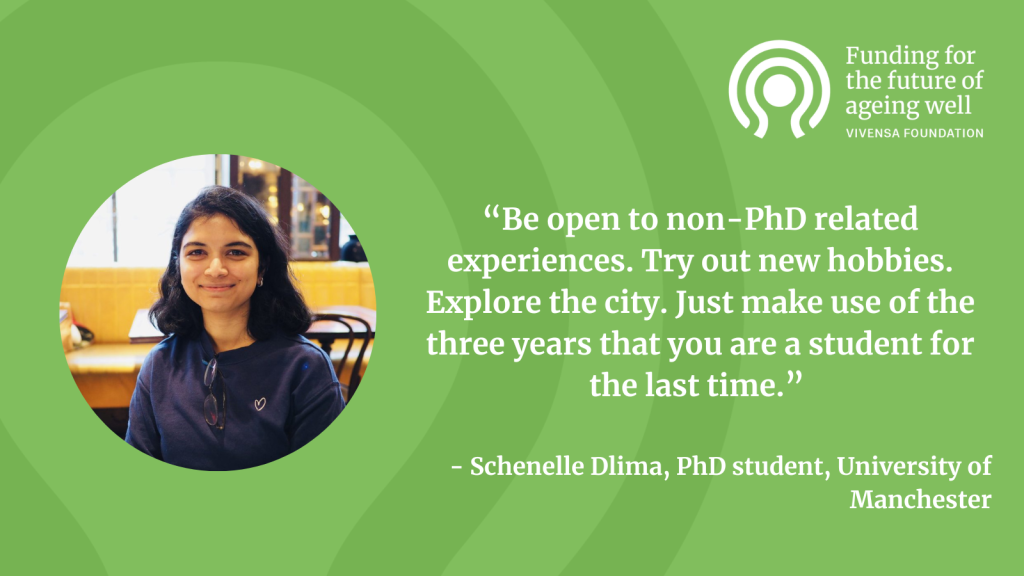
Finishing strong: Navigating the final stretch of a PhD
Schenelle Dlima (University of Manchester) offers a view about navigating the final stretch of a PhD – what it takes to finish, and what comes next.

Schenelle Dlima (University of Manchester) offers a view about navigating the final stretch of a PhD – what it takes to finish, and what comes next.

How can science and lived experience work hand-in-hand to create better outcomes for older adults? We spoke to three Vivensa-funded researchers about the power of patient, carer and public involvement and engagement (PPIE). We talk about the challenges, the breakthroughs, and the lessons they’ve learned from working alongside the people their research is designed to help.

We talk to Professor Tom Kirkwood CBE FMedSci about being funded by us in 1991 and how this propelled his career. We ask him what he’s enjoyed about serving first on our Grants and Research Committee and later on the Board of Trustees.

Read how Prof Mark Hawley at the University of Sheffield is connecting with “seldom-heard” communities to ensure his project is representative and inclusive.

When nearing the end of their life, care home residents with chronic diseases can often find themselves in and out of hospital. This affects their quality of life and is distressing for both them and their families. Prof. Irene Higginson and Drs Anna Bone and Clare Ellis-Smith, from the Cicely Saunders Institute, initiated the Integrated Community Palliative Partnership (ICPP) project to investigate how to improve care for people in care homes with long-term illnesses.

Dr Tim Whitfield at University College London undertook a PhD that looked at predicting the onset of dementia in people with subjective cognitive decline (SCD) and investigated how mindfulness may help prevent cognitive decline.

Despite the UK’s ageing population, there is a lack of training in geriatric care for undergraduate medical students. In collaboration with colleagues, Dr Grace Pearson and Dr Emily Henderson, both at the University of Bristol, have developed a new undergraduate curriculum that delivers more effective training on how to care holistically for older people. They set out to evaluate the training so see whether it can inspire more students to pursue careers in geriatric medicine.

Frozen shoulder is a painful and disabling condition, but how it develops remains unknown. Read how Hamez Gacaferi’s work is starting to unravel this mystery.

It’s best practice for people with diabetes to look after their health by injecting their own insulin. As people get older, however, they are likely to have other conditions that make this harder or unsafe to do. Dr Karen Stenner, from the University of Surrey and Principal Investigator of the CINDI Project, set out to evaluate the emerging practice of registered nurses delegating insulin injections to Healthcare Support Workers in community nursing teams. Could this alleviate workload pressures and bring benefits to patients and nursing teams alike?

When Dr Oliver Todd from the University of Leeds embarked on a Dunhill Medical Trust Research Training Fellowship aimed at finding out whether blood pressure management is linked to an increased risk of falls, it opened up a whole new world of research to improve care for older people.

Almost two-thirds of people aged 65 and over live with musculoskeletal disease, but current methods of predicting who is most at risk have limited use. Through his DMT-funded PhD, academic clinician Dr Nicholas Fuggle made an exciting discovery that could help to predict musculoskeletal ageing ahead of time.

Clinical linguist Dr Lucy Dipper from City University researches the power of storytelling to improve older adults’ communication skills and wellbeing. She and her team set out to design and test the best way of supporting care homes to deliver storytelling activities for their residents.