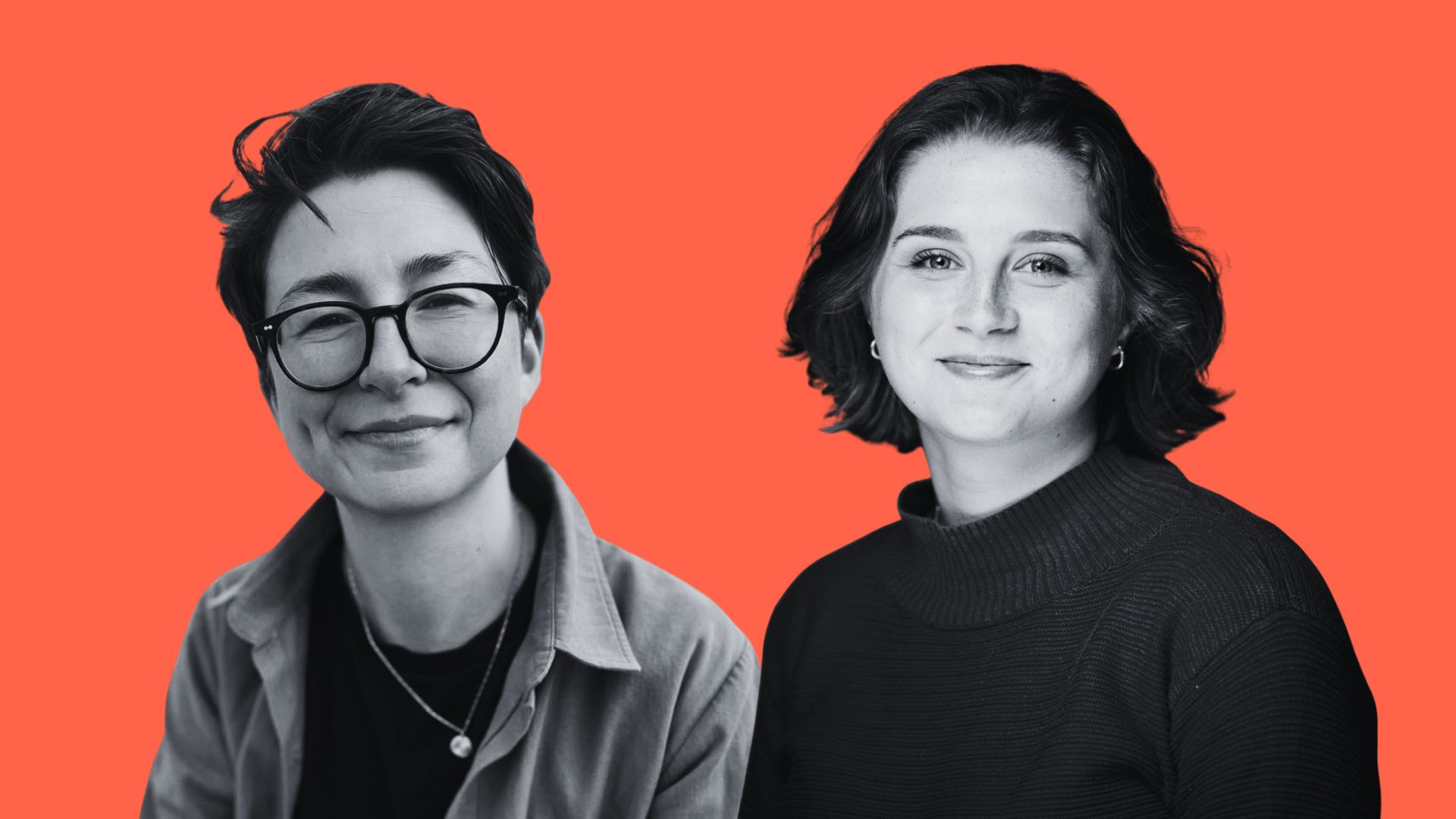
Dr Amy Roberts (King’s College London) and Dr Loren Kell (University of Oxford) met at a Vivensa Foundation Early Career Researcher (ECR) event and turned a coffee-break conversation into an ongoing research collaboration. Here, they reflect on what they’re working on, how it started, and why they think events like this matter.
Some collaborations are years in the making. Others begin with someone stopping in front of a poster during a conference break.
That’s what happened when Dr Amy Roberts stopped at Dr Loren Kell’s poster at a Vivensa Foundation Early Career Researcher (ECR) event. Both are early career researchers working on different pieces of the same puzzle – how the immune system ages, and why that ageing process looks different in women. They didn’t know each other before the event. Now, their labs are working together as a result.
Two angles on the same question
Amy is a postdoctoral research fellow at King’s College London, with a background in genetics and molecular biology. She studies how a specific genetic process – the switching on and off of one of the two X chromosomes women carry – changes as women age, and what that might mean for their health in later life.
As part of a Vivensa Foundation-funded project led by Professor Kerrin Small, her work is exploring whether this could be used as an early marker of immune ageing, as “female-specific disease risk is often under-researched.”
Loren, a postdoctoral researcher in translational immunology at the University of Oxford, comes at ageing from a different angle. Her work looks at how the immune system changes as we get older, and what that means for our ability to fight off infection and respond to vaccines.
“Ageing is the biggest risk factor for getting a chronic disease,” she explains. “You’re more likely to suffer from an infectious disease when you’re older, and less likely to mount a good vaccine response.” Her PhD research focused on cellular senescence – what happens when immune cells accumulate damage, stop dividing and start causing more harm than good – and how to measure it in detail in human immune cells.
A poster, a coffee break, and a conversation
Loren presented her PhD work as a poster at a Vivensa Foundation ECR event in November 2024, the week before her viva. “It felt quite nice to go and show, this is what I’ve done, and finally to have a completed story” she says. Her supervisor had encouraged her to attend. She found it had a different feel to the larger conferences she was used to – more intimate, conversational and valuable. “I feel like I spoke to most people there, which is really fun.”
Amy wasn’t presenting that day, but she was in the crowd around Loren’s poster. “I was fascinated by Loren’s research, and the questions she was able to answer by having developed this assay to measure cellular senescence,” she says.
The two got talking, and it didn’t take long for the overlap to become obvious. “I just got so excited,” Loren remembers, “because that is exactly the thing that I knew I wanted to [do]… I knew I wanted to start research into female health, and I think X chromosome inactivation is a really crucial piece of that.” The conversation ran well past the end of the coffee break. “We just kept lingering,” Loren laughs.
For Amy, she could see the benefit of Loren’s expertise for a related project and it was a natural next step to ask whether she’d be open to collaborating. “It seemed like a perfect chance. I’d recruited the volunteers and isolated the samples, and Loren could apply her assay to them, so we could answer this question in a really robust way.”
Making it official
Good conversations don’t always turn into collaborations, but this one did. Both agree this was probably helped along by there being something concrete to build on. A Teams call followed shortly after the event to discuss next steps, though turning the idea into an active project took time and, inevitably, paperwork.
“It took a really long time for us to get all the sign-offs for the material transfer agreement, so that samples from King’s could be sent to Loren’s lab in Oxford,” Amy recalls. In the meantime, the pair used the wait productively. They talked through the science, the analysis plan, and the hypotheses they wanted to test.
That patience paid off. Loren has now completed the immune senescence profiling on samples from Amy’s cohort of identical twins showing different pattens of X-inactivation skew, and will soon present the findings at a conference. The work is feeding into a larger paper on the molecular and cellular changes linked to skewed X-inactivation, which will be the first of its kind.
Looking ahead, the two are planning to test some of Amy’s epidemiological findings in the lab, including the effects of sex hormones and menopause, using Loren’s in vitro expertise. Loren is also due to visit Amy’s lab at King’s to learn how to measure X-inactivation skew herself. “It’s a skills exchange,” says Amy. “I’ve learned so much from working with Loren. I’m on the periphery of immunology, but I don’t have that in-depth expertise. It’s really exciting when you have a shared interest and can bring different expertise to the table.”
The importance of in-person events
Both are clear that this wouldn’t have happened the same way online. “There’d have been no way for Loren to find out about my research,” says Amy. “I might not have realised her assay was exactly what I needed without her explaining her work to me in person.”
Loren makes a related point about timing. “Once someone’s published their PhD research, that’s often the end point. They’ve moved on to a postdoc, or industry, or somewhere else entirely. You’re looking at what happened before, not what’s happening right now. ECR events catch people while they’re still doing the work. It’s live, rather than something they’ve already finished. I think that’s when collaborations are more likely.”
Amy agrees: “That’s such a good way of putting it. You’re capturing people at the point where they’re saying, ‘this is where I’m at now.'”
They also point to how the event itself was designed. It was smaller and more varied than a typical conference, with attendees grouped around tables to encourage conversation with people they didn’t already know. The workshops (including one on science communication) were built around working together in the room.
“It felt more like a workshop than a typical conference,” says Loren. Amy adds that being surrounded by people at a similar career stage made it easier to approach anyone. “Sometimes you can feel intimidated going to speak to a very senior professor. At an ECR event, it feels more accessible to go and chat to people who might share your interests.”
Their advice for other ECRs
Asked what they’d tell someone considering attending a similar event, both keep it simple. “Just go and talk to people,” says Loren. “I think people like talking about their research. It’s not an imposition, it’s nice.”
Amy points out that it’s easy to talk yourself out of a day away from the lab when your schedule feels full, but cautions against this: “You can get a lot out of a single day event like this. Having that break from your day-to-day routine, being exposed to different types of research, often leads to new avenues of thought.” And, as Loren notes, it costs nothing to find out: “It’s free, which I think is unique, and makes it more accessible. So, if you can go, I would go.”
___________________
Registration is now open for the 2026 UK Ageing Research Funders’ Forum’s Early Career Researcher event. It will take place on 23 November 2026 in London. Find out more and register here.