
For many researchers, the funding application process can feel distant – a black box of forms, deadlines and decisions. But behind every funding call at the Vivensa Foundation is a group of academics who know that process from both sides. The Research Grants Committee (RGC) brings together experts across disciplines and career stages to ensure that funding decisions reflect our values.
We spoke with two members of the RGC – Mariana Borsa, recently appointed Assistant Professor and group leader at the University of Basel, and Stuart Gray, Professor of Muscle and Metabolic Health at the University of Glasgow – about what it’s like to sit on the committee and why the experience is so rewarding.
A seat at the table
When Mariana joined the committee, she was a postdoctoral researcher at the University of Oxford studying immune cell ageing. Her route to the committee was somewhat serendipitous. Her supervisor, Professor Katja Simon, noticed an advert for committee and expert panel members, and asked whether early career researchers could also apply. She suggested Mariana, recognising her expertise in immune ageing. After participating in two expert panels focusing on the ageing immune system in 2021 and 2023, Mariana was invited to join the full committee in 2024.
“It was eye-opening. This was my first time seeing how research funding works from the other side,” Mariana reflects. “As academics, we can become narrow in our focus, always surrounded by people who do similar work. Being part of this committee exposed me to different perspectives. I’m very grateful for the opportunity.”
Now promoted to Assistant Professor, Mariana says being on the RGC has directly influenced her career. “It’s helped me understand how funding bodies operate and what they value, which in turn helps me shape my own research proposals.”
One of Mariana’s biggest takeaways has been about communication. “I’ve learned how important clear communication is. Sometimes a project is brilliant but hard for people outside the field to understand. Seeing that from the other side made me realise how essential it is to write in a way that’s accessible and shows the broader impact of your work.”
Stuart, who has served on the committee since 2023, emphasises the importance of objective decision-making: “Sitting on grants panels helps you have balanced discussion and listen to other people’s expertise and views to inform your thoughts. How do we reach a consensus if two people disagree? We have to come to a collective decision. In everyday life, these are very useful skills.”
When values are more than tick-box exercises
Both researchers highlight something distinctive about the Vivensa Foundation’s approach: values that are genuinely embedded, not just stated.
“I’ve always been impressed by how transparent the process is,” says Mariana. “The Vivensa Foundation’s values are visible in every meeting, from developing new calls to evaluating applications. The committee’s diversity of backgrounds leads to rich, thoughtful discussions. At other funding bodies, equity, diversity and inclusion (EDI) and patient, carer and public involvement and engagement (PPIE) can feel like boxes to tick, but here they’re essential. If applicants don’t show genuine consideration of EDI or PPIE, even a great research idea might be seen as lacking.”
Stuart agrees: “We have had some good applications scientifically that weren’t funded because they were lacking EDI and/or PPIE. Other funding panels only pay lip service to these things, and would probably still fund the project. Vivensa Foundation’s values aren’t just there on paper, they are embedded through the whole application process. Just ticking the box isn’t enough.”
When reviewing applications, the committee looks beyond the science itself. For applied research, they assess whether relevant populations are well considered and how realistic the potential impact is. For fundamental science, they ask how researchers plan to engage the public.
“Some people just copy standard wording, but others clearly think it through,” Mariana notes. “For example, proposing outreach events to explain their research and choosing locations that reach diverse audiences.”
At the Vivensa Foundation, we value when PPIE starts early, even during the proposal-writing stage, because feedback can improve a project’s feasibility and impact. “I haven’t seen that kind of attention to PPIE elsewhere,” Mariana adds. For example, our Academy Ignition Fund gives members of the Vivensa Academy the opportunity to apply for up to £5k for a clearly defined activity or series of activities which considers aspects of involvement, engagement and creating real impact, as well as EDI principles.
There’s also a clear emphasis on ultimate impact. “There’s a strong sense that whatever is funded should ultimately have an impact on the lives of older people,” Mariana explains.
A different kind of funder
Stuart, who has sat on both our RGC panel and that of a much larger organisation describes the contrast as “night and day.” A colleague had told him the Vivensa Foundation operated with “more of a family approach,” and his experience confirmed it.
“The Vivensa Foundation is open and welcoming,” he explains. “Not that other funders aren’t friendly, but there’s a distance there – maybe because of the size of the organisation. When you apply for funding with the Vivensa Foundation, there’s a person to talk to and you can have an honest, open chat.”
He recalls receiving support that went beyond the standard funder relationship: “My funding from the Vivensa Foundation finished just before the COVID-19 pandemic, and I remember they got in touch and asked if we needed any help. There is a lot of flexibility within the funding, and that is really important.”
Stuart also values seeing the complete picture: “Compared to another panel I sit on, with the Vivensa Foundation RGC we see the whole process from start to end. We have the chance to discuss and approve ideas for funding, see them being developed, and feed into the process at RGC meetings. It’s great.”
When asked about the committee’s composition, both researchers identify areas for development. Stuart notes the strong breadth of expertise but suggests the committee could benefit from more diversity and early career researchers. He also points out an emerging gap: “We don’t have anyone with expertise in Artificial Intelligence.”
Why it matters for your career
For early career researchers wondering whether committee work is worth their time, both Mariana and Stuart offer emphatic encouragement.
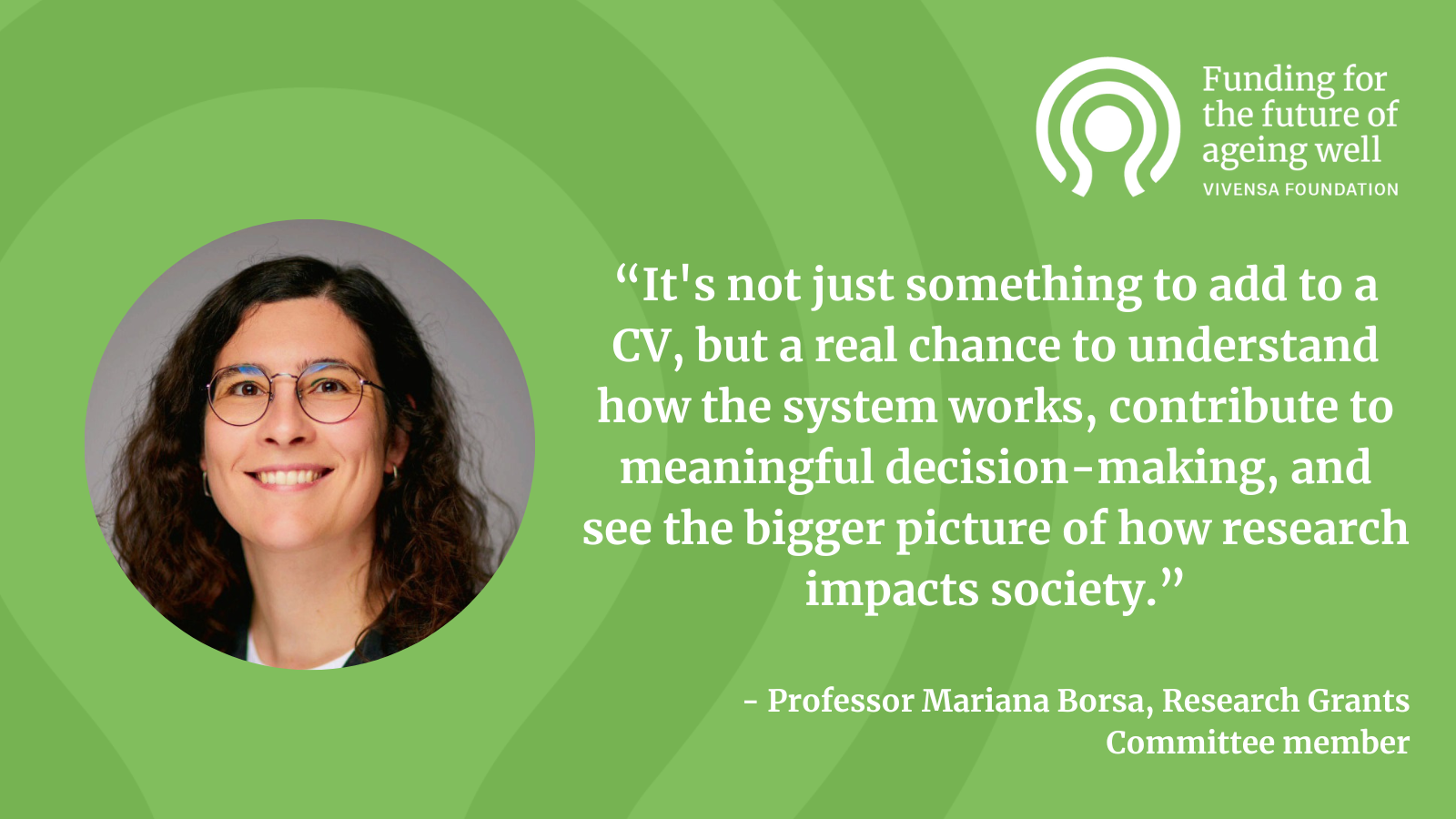
“Absolutely,” says Mariana. “It’s not just something to add to a CV, but a real chance to understand how the system works, contribute to meaningful decision-making, and see the bigger picture of how research impacts society.”
Stuart agrees: “Go for it, definitely. You gain a lot from it, and give a lot back too. You’ll learn a huge amount. It’s good for academic progression, if you’re that way inclined. But more importantly, you’re doing good for science and society by making sure that good science is funded.”
The practical commitment is manageable too. As Mariana explains, committee meetings are scheduled well in advance and are spaced out. Between meetings, committee members volunteer for review panels based on their availability and expertise. “I usually join panels for early career researcher grants because I can relate to their challenges,” she says.
An invitation to join
As the Vivensa Foundation continues to grow and evolve, the RGC will play a vital role in ensuring the Vivensa Foundation’s funding continues to reflect its purpose and values. With regular RGC recruitment cycles, both Mariana and Stuart are hopeful that more early career researchers will get involved.
“It’s been reassuring to see how transparent and ethical funding decisions can be,” Mariana reflects. “It shows that research funding can be done thoughtfully and with real consideration for social impact.”
For researchers at any career stage, the message is clear: committee work offers more than professional development. It provides insight into the machinery of research funding, sharpens essential skills, and offers the satisfaction of contributing to decisions that advance science and improve older people’s lives.
_______________________________________
We are currently recruiting people to join our Research Grants Committee. To find out more about the role and how to apply, please visit our Vacancies page.