
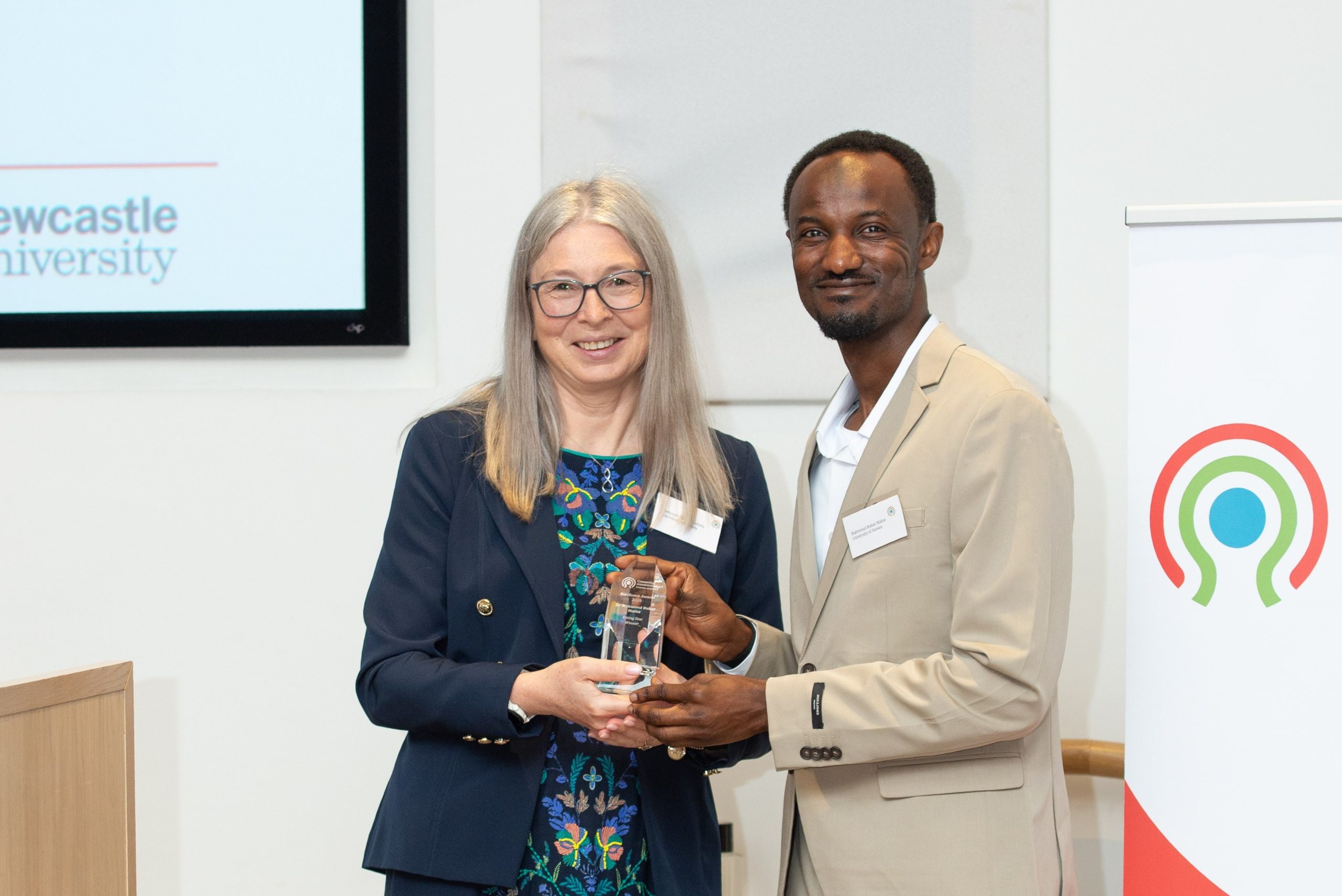
Dr Mahmoud Bukar Maina is one of two recipients of our 2026 Rising Star Vivensa Academy Excellence Award (along with Dr Claire McDonald, who you can read about soon). Here, we talk to him about the research he’s conducting across two continents, how he will use the award to build community engagement in Brighton, and his plans to support the next generation of ageing researchers.
Dr Mahmoud Maina’s research spans two continents and bridges molecular neuroscience and global health equity. He is Director of the Biomedical Science Research and Training Centre (BioRTC) at Yobe State University, Nigeria, and also has an active research programme at Sussex Neuroscience at the University of Sussex. His research focuses on the molecular mechanisms of Alzheimer’s disease, both in healthy brain cells and in neurodegeneration. Originally trained in Human Anatomy at the University of Maiduguri in Nigeria, he went on to complete a PhD in Neuroscience at the University of Sussex.
Mahmoud is now investigating how genetic ancestry influences Alzheimer’s disease mechanisms. Most of our understanding in the field has come from the European ancestry population. Minority groups have not been captured in these studies, and neither have other populations. He explains: “There’s a lot of diversity in the human species so my long-term goal is to bring together our understanding from different populations.” By understanding ancestry-linked risk and resilience, he hopes that future therapies will be effective for diverse populations globally.
Pioneering work, from Africa to the UK
As a Wellcome Trust Career Development Fellow, Mahmoud’s research in Africa is funded for the next eight years. He has been building a cohort of people that have dementia, as well as older people that don’t, in order to better understand how genetics, environment and lifestyle play a role in the disease. Mahmoud explains: “We now have a cohort of over 1,200 older people in Africa, and this is something I’d like to replicate in the UK.”
There are a lot of people with African ancestry in the UK, as well as other minority groups who traditionally don’t participate in research and are not engaged in terms of diagnostics or clinical interventions. Over the three years of the Excellence Award, Mahmoud hopes to develop a pilot scheme to build a research cohort in the UK, mirroring the work he has done in Africa. If the data gathered by the end of the three years is robust enough, the aim is to attract future funding to expand the work.
Community engagement
The first thing he will do with the award funding is recruit a community engagement officer in Brighton. Their job will be to engage with different groups and NGOs and start to build relationships and trust in the community. By understanding people’s thoughts, fears and beliefs around brain health and dementia, Mahmoud hopes it will open the door for engagement and interaction. He says: “I have 13 years of experience engaging with the community in Africa, but I know the environment is different here. I hope the community engagement officer will use their experience to build long-term relationships that will lay the foundation for future research cohorts.”
Building the next generation
Mahmoud’s long-term mentor, Professor Louise Serpell, nominated him for this award. He says of her: “She is an incredible human being and so supportive – a true believer of building the next generation. She was my first supervisor when I came to the UK, and she’s helped me to develop all that I’m doing in Africa and the UK.”
This experience of having a supportive mentor has given Mahmoud even greater cause to pay it forward. He is already deeply committed to capacity building and public engagement, and will use the award in part to fund student placements so he can nurture the next generation. “If we want to solve complex diseases like Alzheimer’s, we need scientists who understand different populations, different systems, and different realities. That’s why I think it’s important to create opportunities for others to get involved in this kind of research.”
___________________
Connect: Mahmoud is looking forward to connecting with members of Vivensa Academy– particularly researchers, clinicians, and community organisations interested in improving how dementia research engages with underrepresented populations within and outside the UK, and in building pathways from community engagement to meaningful research participation. If you’d like to contact him, you can get in touch via his member profile.
Nominate: Do you know a rising star in ageing-related research? Our 2027 Excellence Awards will open in September 2026. Members of Vivensa Academy can self-nominate or nominate others. They must explain how they have demonstrated research excellence and a genuine commitment to our key values for research.
Also in the series: Read about our 2026 Team Achievement winners here. Articles about our other 2026 Rising Star, Dr Claire McDonald, and our 2026 Senior Leader, Professor Nathan Davies, are coming soon.